River Adventures vs. Lake Days: Which Is Better for a Nature Weekend?
October 28, 2026 - Travel Guides

October 27, 2026 - Travel Guides
Rivers are not uniform sheets of moving water. From a safe seat on the bank you can pick out the fast lanes, the slack pockets and the seams where two flows argue with each other — and those details tell you far more about whether a swim or a paddle is sensible than one glance at the surface ever will.
The skill is old and unglamorous. Stand still, look upstream, and give your eyes a couple of minutes to adjust. What first looks like texture starts to resolve into structure: a line of foam here, a dome of water there, a patch of glassy smooth water that shouldn't be smooth at all.
Good river reading is not a single glance, either. Water level, recent rain and the shape of the channel all change what a feature means. A gentle eddy at low flow can become a churning pocket after a night of rain. A riffle you could wade last week can be a fast, waist-deep chute today. Read the river in front of you, not the one you remember.
A riffle is the rumpled, broken stretch of water running over gravel or shallow rock. It catches the light in a hundred small wrinkles and makes a steady chuckling sound you can hear from the bank. Riffles are usually the shallowest parts of a river, and in low water they are often where you can wade across without the river reaching your waist.
Don't mistake shallow for easy. That broken surface is hiding stones, and a foot wedged between two of them in fast water is one of the oldest river accidents there is. Read the top and tail of the riffle instead: the tail-out, where the broken water flattens into the pool below, is normally the calmest place to enter, stand or launch. The head, where smooth water first breaks, is where the push is strongest.
Where a riffle drops into a pool, look for a line of standing waves. Those waves aren't travelling downstream; they're the river piling over something below. If they are tall, glassy and keep their shape, there is weight under them. Small, soft waves that collapse and reform are usually a sign of less power, though they still deserve respect.
Riffles are also useful markers. If you can see a clean tail-out and a shallow gravel bar, you have found a natural place to scout from. If the whole riffle is a uniform band of white water with no soft edge, the river is telling you that the easy line is either somewhere else or not there at all.
Push a hand into a bathtub and the water curls back behind it. Rivers do the same at a larger scale. Behind any rock, bridge pier or point of land, part of the flow turns and runs back upstream or stalls in a slow rotation. That pocket is an eddy, and the boundary between it and the main current is the eddy line.
Eddy lines are among the easiest features to spot once you know what you're looking at: a crisp seam on the surface, often marked by foam, bubbles or a little raft of leaves turning in a slow circle. On a breezy day they look like a wrinkle in fabric that won't smooth out.
For a paddler, an eddy is a resting place — the spot you aim for to catch your breath or wait for a companion. For a swimmer, it can be a safe pocket to stand in at the edge of a strong flow. But the seam itself carries a pull, because water is being dragged from the fast lane into the slow one. Watch a leaf make the journey before you trust the line with your own body.
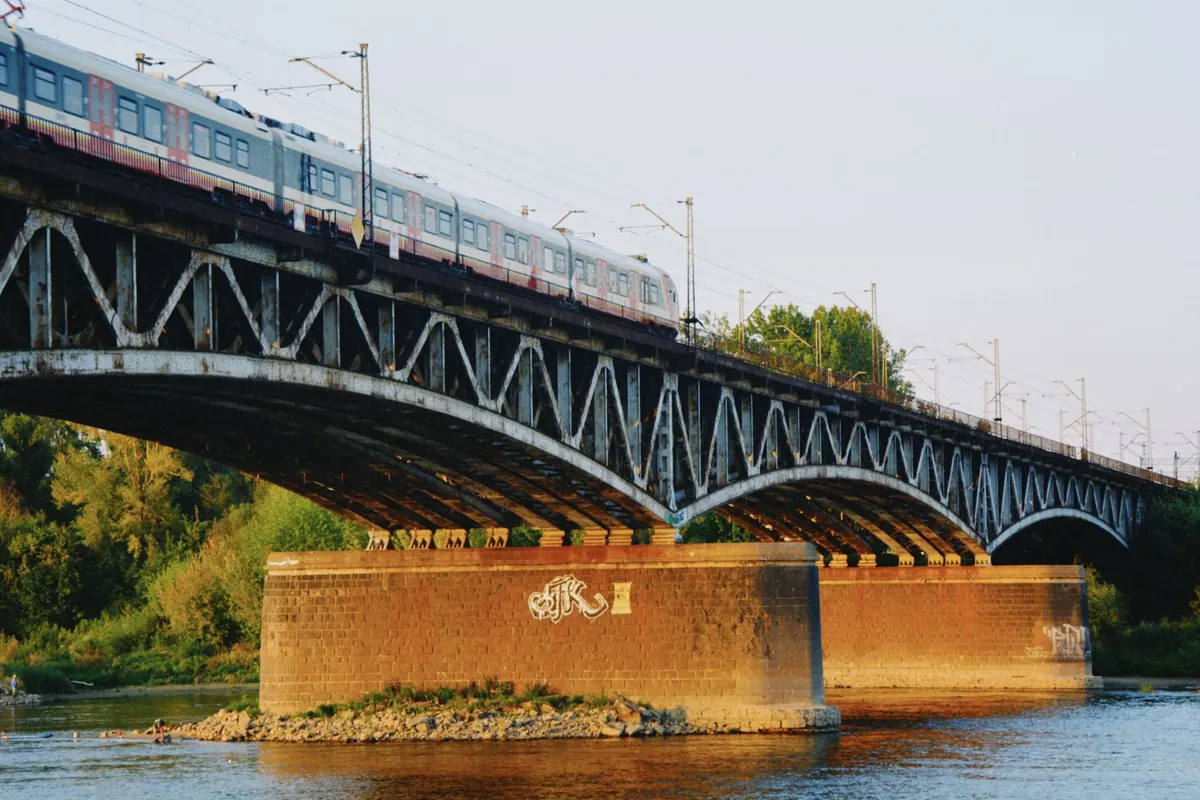
A bridge pier is a good place to study the pattern. The current accelerates around the pier, then curls back behind it. The eddy may look calm enough to sit in, but the seam can be sharp and the water below it can be deeper than it appears from the bank. The same is true behind a midstream boulder: the pocket is useful, but the approach is where the current is doing its work.
A boil is water coming up rather than going past. It shows as a rounded mound or a churning patch that rises, spreads and flattens, sometimes with a small plume of bubbles or debris at its centre. Boils tend to appear below deep drops, in narrow channels, or where a strong current is forced around something large below the surface.
Treat a boil as a message about depth and power. Where water is welling up from below, a lot of it is moving down there, and the surface gives you no view of what it is moving around. Boils also stir up colder water from the bottom, which is worth knowing on a hot afternoon: the calm-looking pool below a weir can be noticeably colder than the shallows you just walked through.
A boil isn't automatically a "do not enter" sign, but it is a prompt to look harder. If it sits in the middle of an otherwise smooth approach, ask what is causing it. If it appears below a drop or beside a narrow chute, assume the water underneath is doing more than the surface suggests.
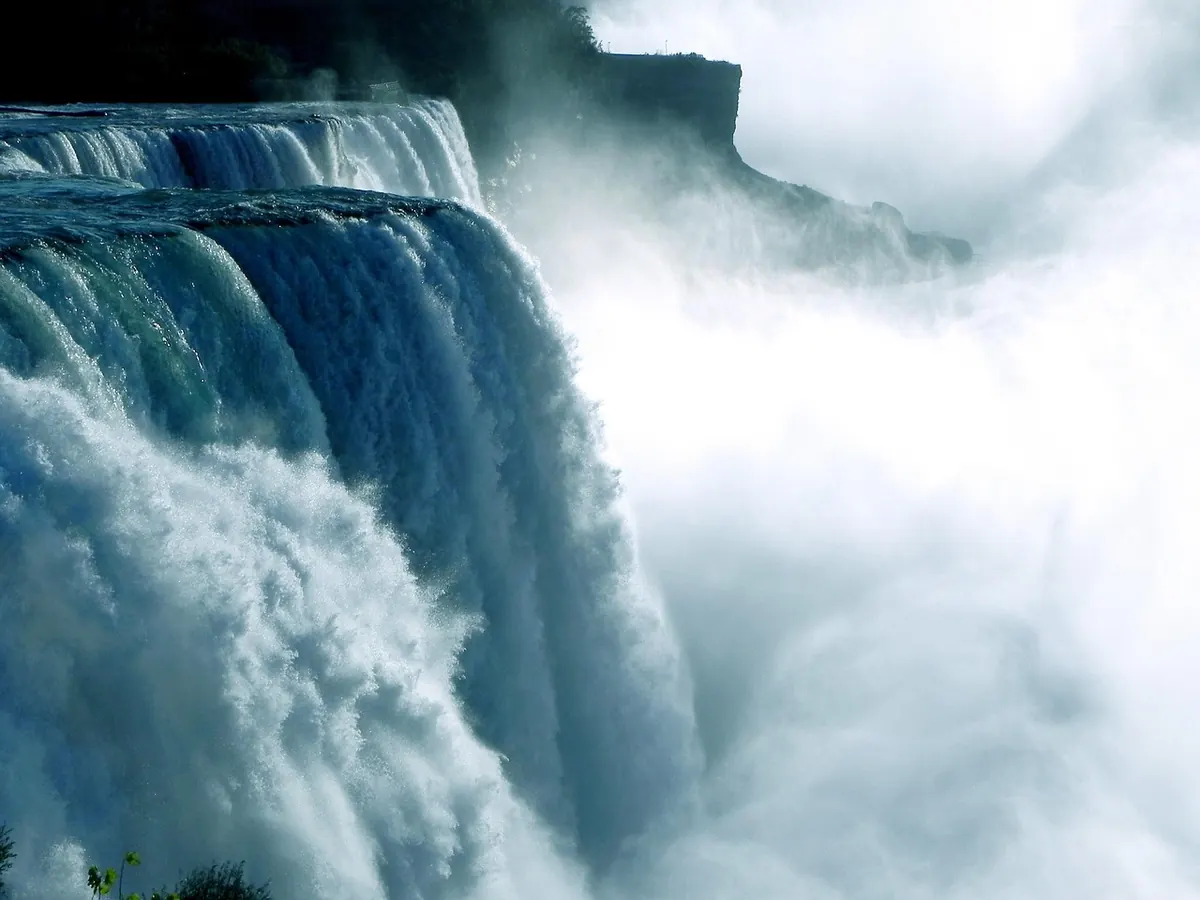
The most deceptive water on any river is the water that looks calm. A smooth, unbroken tongue sliding over a ledge or a weir is often the top of a recirculating hole: the surface flow dives, curls back on itself, and holds whatever is caught in it. The glassy look is not peace. It is water with nowhere to go but down and around.
Below such drops you get the return flow people call an undertow — surface water drawn down and pushed back out underneath. It is rarely the cartoon whirlpool that drags swimmers to the bottom, but it is strong enough to hold a person under a falling curtain of water, and that is the danger.
While you're scanning, keep an eye out for these, which the surface often hides until you are on top of them:
Current is not made only by objects. The shape of the channel does most of the work. On a bend, the fastest water usually runs along the outside edge, where it cuts into the bank and forms the deeper channel. The inside of the bend is often shallower, slower and marked by a gravel bar or a beach. That inside edge can look inviting to a swimmer, but it may also shelve off quickly into deeper water.
Constrictions have the opposite effect. Where the river narrows between banks, around a bridge or through a rock garden, the same volume of water has to move faster. The surface may look tidier there, but the push is stronger, the eddies behind obstacles are sharper, and the consequences of a missed line are greater.
Confluences are worth watching too. Where a tributary meets the main river, two currents often run side by side for a while, marked by a seam of foam or a change in colour. A paddler can use the slower side as an entry or exit; a swimmer should treat the seam as a place where the flow can change direction without warning. Look at the banks as well: undercut earth, exposed roots and overhanging vegetation all tell you where the river has been working away at the edge.
Before you wade, swim or launch, turn reading into a routine. It takes a few minutes and it is far cheaper than learning the same lessons in the water.
If you can't explain where a stick will go, don't put your body there.
Reading a river doesn't remove risk. It does something more useful: it turns a blind guess into a decision. The riffles show you the bones, the eddy lines show you the seams, the boils show you what is pushing up from below, and the glassy tongues warn you what is pulling down. Learn to read them from the bank first, and you will make better choices long before you are in the water.
Photo: urformat / Pixabay
Rivers reward curiosity and planning; lakes reward simplicity and slow mornings. Here is how access, safety, crowds...
A practical, step-by-step plan for building a three-day river itinerary that runs on trains, buses and footpaths —...
October 27, 2026 - Travel Guides
Copyright © 2026 Scrigno Del Fiume. All Right Reserved.